


Moving With Culture Without Losing the Brand
Sure, culture rewards speed. But brands, especially legacy brands, rarely benefit from aimless speed.
Every new platform, behavior, sponsorship opportunity and consumer trend gives marketers another possible direction to pursue. The harder decision is determining which of those directions genuinely belongs within the brand.
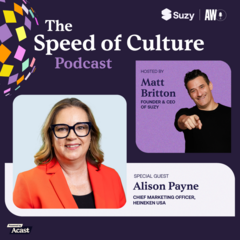
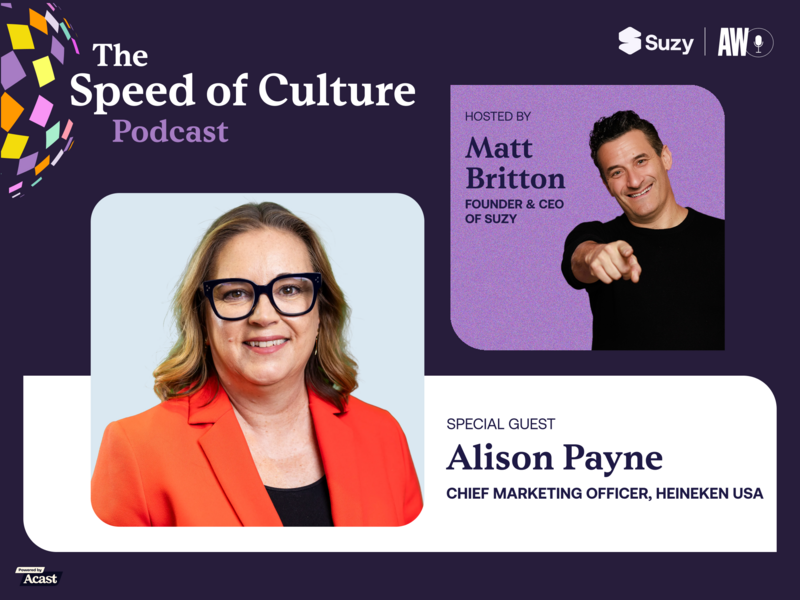
This week on The Speed of Culture podcast, Matt Britton speaks with Alison Payne, Chief Marketing Officer at Heineken USA, about how Heineken approaches that tension. Across experiential marketing, fandom, AI, non-alcoholic beer, packaging and creative leadership, one principle keeps resurfacing: relevance only works when consumers connect with what your brand has always been.
Start With What the Brand Actually Stands For
Alison has worked across categories ranging from beer and spirits to snacks and wellness, but one rule has stayed consistent throughout her career: be clear about what the brand stands for and never lose sight of it; not even for culture.
At Heineken, that idea goes back to founder Freddy Heineken’s belief that the company does not simply sell beer. It sells good times. That distinction gives the brand room to adapt because the product is not the only lens through which opportunities are judged.
Gaming makes sense when it becomes a meaningful way people socialize. Non-alcoholic beer makes sense when moderation becomes part of how people want to enjoy a night out. Live sports and music make sense because fandom creates moments of shared connection. The behaviors evolve, but the underlying human need remains recognizable.
The Event Has Already Begun
One of the clearest examples of that evolution is experiential marketing. Traditional sponsorship could often be reduced to what Alison calls “badge sponsorship”: put a logo on the property and make sure consumers see it. That model no longer reflects how people experience events.
Before Coachella begins, audiences are already discussing outfits, artists, plans and predictions. During the festival, the conversation becomes real time. Afterwards, the photos, collectibles, memories and stories continue circulating.
Heineken approaches properties such as the US Open in the same way. The event itself becomes one part of a much longer consumer journey.
For marketers, that changes the value equation. The question is no longer “did people see our logo?”. It’s “was our brand part of the cultural conversation?”
Fandom Is a Social Shortcut
Heineken’s “Fans Have More Friends” platform begins with another simple insight: shared passions make social connection easier.
Alison describes how her husband, a lifelong Arsenal supporter, can arrive in a bar anywhere in the world and find someone to talk to when the team is playing. The fandom supplies the opening line. That is particularly relevant for a brand whose purpose is tied to social connection. Instead of treating sports simply as a media property or athletes as borrowed reach, the opportunity becomes helping fans experience the social side of their passion. In fact, the strongest role for a brand may be the one that makes the connection between people easier.
AI Should Accelerate Work, Not Manufacture the Moment
Alison sheds light on a new and different kind of tension that AI has introduced. Heineken is actively experimenting with the technology, including using it to simulate creative ideas before investing in full production. Teams can visualize a concept quickly, put it in front of consumers, get an early read, and decide whether it deserves more investment. AI can also remove some of the reporting, summarization and administrative work that consumes marketers’ time.
But Alison draws a boundary around authenticity. A brand built around real people sharing real moments has little to gain from manufacturing artificial versions of those experiences simply because the technology makes it possible. The useful question is therefore not whether AI can create the content; of course it can. It is where AI can create more time for marketers to do the work that still needs human judgment.
Moderation Is Changing the Occasion
The growth of non-alcoholic beer offers another example of why consumer behavior matters more than old category assumptions. When Heineken launched 0.0 in the US in 2019, the non-alcoholic category carried very different associations. Alison describes products sitting on the bottom shelf, poor taste perceptions and limited consumer relevance.
Today, the behavior surrounding moderation is changing. “Zebra striping” describes consumers alternating between alcoholic and non-alcoholic drinks. “Social marathoning” describes the desire to remain part of a long social occasion while maintaining control. Neither behavior rejects the social experience. Instead, consumers are changing what they need from the product during different parts of that experience.
For marketers watching cultural change, this distinction matters. Innovation can emerge from understanding how an existing occasion is evolving, rather than inventing an entirely new one.
Strategy Lives in What Gets Rejected
The conversation eventually returns to a lesson Alison learned early in her career: strategy is more about what you are not going to do than what you are going to do.
That idea becomes increasingly valuable as the number of possible marketing decisions expands. Brands can participate in endless cultural conversations. Teams can keep pet projects alive long after their value has disappeared. Large organizations can add so many perspectives to a creative idea that the original idea becomes difficult to find.
Leadership requires stopping some of that motion. It means killing weak projects before they consume years of attention and protecting ideas while they are still fragile enough to be diluted by consensus. Most of all, it means knowing when a cultural opportunity does not belong to the brand, even when everyone else appears to be participating.
Moving at the speed of culture therefore requires something that can look surprisingly slow: judgment. The brands that keep their relevance are not necessarily the ones reacting to the most change. They are the ones that know which changes matter to them.